
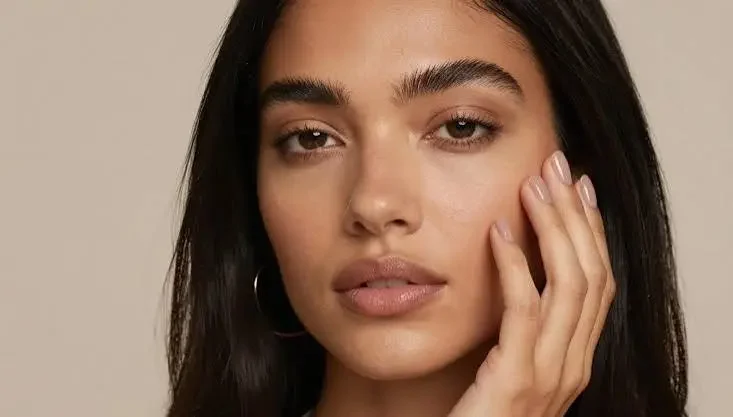
Deep olive undertones are one of the most striking and most misunderstood skin types in the world. If you have a deeper complexion with a muted green-gold cast, foundations consistently oxidize on you, and standard color advice always feels slightly off, this guide is written for you. Dark olive undertones at deeper depths come with their own specific rules — for color, makeup, and skincare. Here is a complete, depth-specific resource that covers everything competitors have missed.
Table of Contents
What Are Deep Olive Undertones?
Deep olive undertones describe a skin quality at higher melanin levels where the underlying tone carries a rich green-gold or green-brown cast. Unlike lighter olive complexions, dark olive undertones sit at a deeper depth, meaning the skin reads as medium-dark to dark, with that characteristic earthy, muted quality that sets olive skin apart from both warm golden and cool ashy complexions.
Skin color at this depth is shaped primarily by eumelanin, the brown-to-black pigment that accumulates in higher concentrations. The visible olive cast comes from the interaction between this melanin concentration and the natural undertone pigment beneath the surface. On the Fitzpatrick scale, deep olive complexions typically fall between Type IV and Type V, meaning the skin tans easily, burns less frequently, but remains vulnerable to hyperpigmentation from UV exposure and inflammation.
Deep olive is not simply “dark skin with a warm undertone.” The green-gold element distinguishes it from golden-warm or straight neutral complexions. This is why many foundations labeled “warm deep” or “golden deep” still oxidize orange or look flat on dark olive undertones — they are formulated for a different undertone altogether.
How to Identify a Deep Olive Complexion
What to Look For
The most reliable way to identify deep olive undertones is to check your face, jaw, and neck in indirect natural daylight. Deep olive skin typically shows a muted green-gold or earthy-neutral cast rather than a clear warm glow or cool pink tone. It may look rich and almost bronzed in sunlight, then shift to a slightly ashen quality in cooler indoor light — this shift is one of the signature behaviors of dark olive undertones.
Foundation matching is a reliable indicator as well. If shades at the correct depth look too orange, too ashy, or slightly greenish once blended, deep olive undertones are almost certainly responsible. Brands that mark their deeper shades as “warm” often still miss the mark because warm-leaning formulas do not account for the green element in the undertone. If this problem has followed you across multiple brands and formulas, dark olive undertones are the explanation.
If you are comparing across the olive spectrum, reading about medium olive undertones alongside this guide helps clarify where medium olive ends and deep olive begins — useful context for anyone whose depth feels ambiguous between the two.
The At-Home Draping Test for Deep Olive Skin
A simple fabric comparison works well for confirming deep olive undertones and identifying their temperature lean. Hold a deep warm ivory and a cool white fabric under your chin in natural daylight and compare how each affects the overall impression of your face. Warm ivory should look more settled next to deep olive skin; cool white often creates an ashy, separated effect.
For the second comparison, use a deep tomato red (warm) alongside a deep berry or burgundy (cool). The color that makes your face look cleaner, more even, and more cohesive indicates your temperature direction. For deep olive specifically, keep both test fabrics at a similar depth — pale or washed-out fabrics can introduce depth issues that distort the temperature result. Note which specific shade worked rather than just recording “warm” or “cool,” since within each temperature there is significant variation that matters at deeper depths.
Deep Olive Undertones: Warm, Cool, or Neutral?
Warm Deep Olive
Warm-leaning deep olive undertones carry more of a golden-green quality. The green element is still present, but it sits closer to gold and olive-brown rather than cool grey-green. This complexion typically responds well to deep earthy tones, warm-tinted neutrals, and rich reds with orange leanings. Warm-leaning dark olive complexions are common across South Asian, Middle Eastern, and Latin American backgrounds, though they appear globally.
Cool Deep Olive
Cool-leaning deep olive undertones have a more pronounced blue-green or grey-green cast. These complexions often look striking beside jewel tones with cool bases — deep sapphire, rich plum, forest green, and cool burgundy all tend to work very well. Cool-leaning deep olive skin may also look cleaner beside charcoal than beside warm brown, which can be a useful identifier. This temperature lean is less commonly discussed in beauty content, which is why many cool-leaning dark olive people end up with advice that does not quite fit.
Neutral Deep Olive
Some deep olive complexions sit genuinely at neutral, meaning neither a warm nor a cool fabric wins consistently in a draping test. These skins typically do best with rich, saturated colors at a similar depth, and both antique gold and brushed silver tend to look equally flattering as metals. Neutral deep olive skin is perhaps the most flexible of the three, but it still requires depth-appropriate choices — pale or icy versions of any color will still wash it out.
Best Colors for Deep Olive Undertones
Clothing Colors That Work
Deep olive undertones come with a specific and powerful color range. Rich, saturated tones almost always outperform pale or muted ones at this depth, and colors that balance the green-gold quality of the undertone tend to look the most natural against the skin.
Colors that consistently work for deep olive complexions:
- Forest green and deep evergreen — echo the undertone without overwhelming it
- Sapphire blue and deep teal — provide cool contrast that balances the warm-green base
- Warm burgundy and deep plum — rich, grounded, and flattering across all deep olive temperatures
- Copper and warm bronze — complement the green-gold quality directly
- Espresso, charcoal, and deep navy — strong neutrals that provide contrast without grayness
- Aubergine and deep violet — work particularly well on cool-leaning deep olive complexions
Colors to avoid at deep olive depth:
Icy pastels, pale beige, lime green, and bright mustard tend to create problems for dark olive undertones specifically. Icy shades amplify any grey in the undertone, pale beiges look flat and disconnected from the skin, and lime green or mustard both exaggerate the green element in an unflattering way. Bright orange is another shade to approach carefully — at deeper depths it can clash sharply with the green-gold quality of the undertone.
Color Contrast for Deep Olive Skin
Depth creates an important variable for dark olive complexions — specifically around contrast. People with deep olive skin, dark hair, and strong features tend to carry high-contrast combinations well: deep navy with bright teal, black with copper, espresso with warm red. Those with softer features or who prefer lower-contrast styling do better with tonal combinations within the same rich-but-muted range, such as deep olive paired with warm burgundy, or charcoal with deep teal.
Foundation and Makeup for Dark Olive Undertones
Finding the Right Foundation at Deep Depth
Foundation shopping is particularly difficult for dark olive complexions because most brands at deeper shade ranges lean either warm-golden or cool-ashy, with very few neutral-olive options. The “O” designation used by some brands to indicate olive is helpful when it appears, but it is inconsistent across the industry. At deeper depths, the most useful strategy is to look for shades described as “neutral-deep” or “deep neutral-olive,” swatch on the jaw in natural daylight, and allow 10 minutes before judging to catch oxidation.
Brands with viable deep olive shade options include Fenty Beauty (shades 345, 425, 445 in the matte formula), About Face (shades D3O, D2O, D1O), Lisa Eldridge (shade 35), and Kett Cosmetics (cream shades 7, 9, 11). A mixing strategy also works well — a drop of green-toned mixing pigment added to a too-warm deep foundation neutralizes orange oxidation without sacrificing depth. This is a consistently recommended technique among the deep olive beauty community and is far more cost-effective than cycling through multiple full-size foundations.
Blush for Deep Olive Complexions
At deeper depths, blush needs real pigment to show. Terracotta, warm brick, deep berry, and rich peach with warmth all perform well on dark olive undertones. These shades have enough depth to read clearly against the skin and complement the undertone without creating an ashy or flat effect. Cool pink blushes and icy roses tend to sit on top of the skin at this depth, looking artificial rather than natural. A terracotta or deep muted berry blush, applied with a light hand and built up gradually, creates the most believable flush on deep olive skin.
Eye Makeup for Dark Olive Undertones
Deep olive undertones at this depth respond particularly well to rich, warm eyeshadow shades: copper, deep bronze, warm plum, espresso, and forest green all complement the undertone and add depth without overwhelming the eye. Navy and deep teal work well as liner shades. Chalky nude shades and pale shimmer tend to disappear against deeper skin, so opting for shades with real pigment and warmth gives better definition and longevity. Eggplant and aubergine are especially effective for cool-leaning deep olive eyes, creating contrast that makes the whites of the eyes look brighter.
Lip Color
The most flattering lip shades for dark olive undertones are those with warmth, depth, and real pigment: deep brick red, warm cranberry, oxblood, rich plum, deep berry, and warm cocoa. These shades complement both warm and cool leans within deep olive, and they provide enough contrast against deeper skin to look polished. Pale nude shades that work on lighter complexions tend to look flat or washed out on deep olive skin. A warm cocoa nude with depth, or a deep rose-mauve, gives the most natural daytime option without losing vibrancy.
Skincare for Deep Olive Undertones
Deep olive complexions sit toward the higher end of the Fitzpatrick scale, which means stronger natural UV protection from increased melanin — but this does not eliminate the need for consistent sun protection. Hyperpigmentation is the primary skincare concern for dark olive undertones, since increased melanin can produce uneven dark spots more readily after inflammation, breakouts, or sun exposure.
A reliable daily routine for deep olive skin includes a broad-spectrum SPF 30 or higher applied every morning, regardless of cloud cover or skin type. Brightening ingredients — vitamin C (ascorbic acid or THD ascorbate), niacinamide, azelaic acid, and tranexamic acid for established dark spots — help manage uneven pigmentation over time without stripping the skin. Gentle exfoliation two to three times a week using lactic acid or mandelic acid lifts surface dullness and supports a more even surface tone. Consistency matters more than intensity here — aggressive treatments can trigger new inflammation and worsen hyperpigmentation on deep olive complexions.
Common Mistakes With Deep Olive Undertones
The most frequent mistake is treating deep olive the same as warm-dark or neutral-dark skin and selecting foundations or clothing accordingly. Most “warm deep” makeup shades are formulated for golden or peachy undertones, not green-gold ones. The result is foundation that turns orange within hours, blush that looks disconnected, and clothing colors that make the complexion look muddier rather than richer.
A second common error is relying on the vein test as a primary identifier. On deep olive skin, veins often appear blue-green or even teal — a combination that can point in multiple directions depending on who interprets it. The fabric draping test described earlier in this guide is far more reliable because it shows how the skin itself responds to different color temperatures, rather than relying on a secondary indicator.
Finally, many people with deep olive undertones avoid rich, saturated colors out of concern they will be “too much.” At this depth, saturated colors are actually more balanced — the skin’s depth and the color’s depth meet in the middle and create harmony. Pale, washed-out versions of any color are far more likely to create an imbalanced look on dark olive complexions.
FAQ: Deep Olive Undertones
What are deep olive undertones exactly?
Deep olive undertones describe a darker skin depth — typically Fitzpatrick IV to V — with a muted green-gold or green-brown undertone that is neither clearly warm nor clearly cool. The green element distinguishes deep olive from both golden-warm and ashy-cool complexions.
How do I know if I have dark olive undertones?
Check your jaw and neck in indirect natural daylight. If the skin has a muted green-gold or earthy cast, and foundations at the correct depth consistently turn orange or ashy on your jaw, dark olive undertones are very likely. A fabric draping test using deep warm ivory versus cool white is the most reliable home method.
Is deep olive skin warm or cool?
Deep olive complexions can lean warm, lean cool, or sit at neutral. The olive quality and the temperature direction are separate traits. A fabric comparison test at similar depths is the most accurate way to identify your specific lean — vein color alone is not reliable at deep olive depths.
What foundation shades work for deep olive undertones?
Look for shades with “neutral-olive,” “deep neutral,” or an “O” designation. Brands with verified deep olive options include Fenty Beauty (345, 425, 445), About Face (D3O, D2O, D1O), and Lisa Eldridge (shade 35). Always swatch on the jaw in daylight and check for oxidation after 10 minutes.
What colors should deep olive skin avoid?
Icy pastels, pale beige, lime green, mustard yellow, and bright orange tend to work against dark olive undertones. At deeper depths, these shades either amplify the grey in the undertone, exaggerate the green cast, or simply look disconnected from the skin.
What is the best blush for dark olive complexions?
Terracotta, deep berry, warm brick, and rich peach with depth work best. Avoid icy pink and cool rose blushes — they tend to sit on top of rather than blend into deep olive skin.
Does deep olive skin need special skincare?
Yes. Hyperpigmentation is the primary concern — increased melanin at this depth means dark spots develop more easily from sun exposure and inflammation. Daily SPF 30+, vitamin C, niacinamide, and gentle exfoliation with lactic or mandelic acid form the core routine.
Can deep olive skin wear black?
Yes. Deep saturated neutrals including black, charcoal, espresso, and deep navy all work very well on deep olive complexions. They provide clean contrast without creating the grayness that paler or icier shades cause.
Final Thoughts
Deep olive undertones are specific, rich, and deserve far more tailored guidance than most beauty systems provide. The key is recognizing that dark olive complexions are not simply “warm deep” or “neutral dark” — the green-gold element requires its own approach across foundation, color, and skincare. Start with the fabric draping test to confirm your temperature lean, build a foundation routine around neutral-olive formulas at the correct depth, and reach for rich, saturated colors that match the depth and vibrancy of your complexion. Deep olive skin has a warmth and complexity that the right colors bring out beautifully — it is just a matter of knowing which ones those are.
